Taxes
GST is not a side note. The local data points show 5 percent on basic cost and parking, plus 18 percent on the other-charge bucket. Buyers should always ask which quoted figure already includes tax and which does not.

Current Habulus Tranquil pricing, charge heads, payment timing, and the full budget logic behind the project's 2 BHK and 3 BHK inventory in Electronic City Phase 1.
Habulus Tranquil is currently anchored at a base sale value of ₹7,499 per sq ft, but that number is only the first line in the commercial stack. Parking, clubhouse charges, other charges calculated per sq ft, floor rise, GST, corpus, maintenance, and legal or khata transfer costs all move the final outflow upward. In practice, the number that matters is the all-inclusive cost for the exact configuration, floor, and tower position under discussion.
The local cost record also shows why this project should be read as a family-housing value decision rather than just a launch-rate advertisement. The 2 BHK sits around ₹1.13 crore for the 1,292 sq ft Tower C reference, the 3 BHK (2T) around ₹1.46 crore, and the 3 BHK (3T) around ₹1.53 crore. That spread is meaningful, but it is also attached to real changes in usable room count, family flexibility, and long-hold suitability.
Electronic City Phase 1 attracts both end users and investors because of its employment base, but Habulus Tranquil's pricing feels most coherent for owner-occupiers who plan to use the home for several years. The project is not trying to win purely on the lowest possible ticket. It is trying to support its commercial position with larger layouts, a 5-acre site, 4-tower density, and a wider amenity mix.
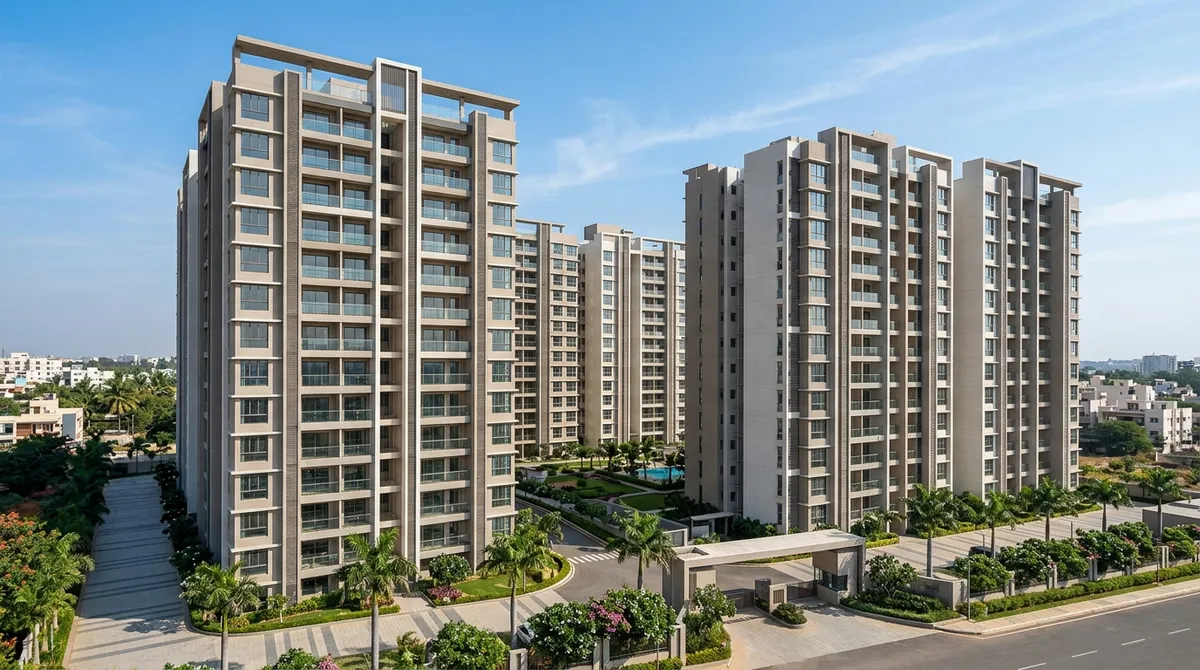
At Habulus Tranquil, the layout sizes, open-space positioning, and family-focused planning are central to whether the price ladder feels justified.
| Configuration | Area | Reference price | Product reading |
|---|---|---|---|
| 2 BHK | 1292 sq ft | About ₹1.13 Cr | Lower ticket, but still a full-size family home |
| 3 BHK (2T) | 1694 sq ft | About ₹1.46 Cr | Middle-family format with a genuine third room |
| 3 BHK (3T) | 1781 sq ft | About ₹1.53 Cr | Largest and most flexible long-stay layout in the project |
These figures follow the local Tower C source set that anchors this website.
| Component | Current note |
|---|---|
| Base sale value | ₹7,499 per sq ft |
| Car parking | ₹3,00,000 |
| Other charges | ₹350 per sq ft plus GST |
| Clubhouse charge | ₹2,50,000 |
| Floor rise | ₹25 per sq ft per floor from the second floor |
| Possession-stage items | Corpus, maintenance, legal transfer, registration, and statutory costs |
The gap between base rate and landed cost is why all-inclusive comparison matters so much on this project.
The published project record currently places the 2 BHK at 1,292 sq ft around ₹1.13 crore, the 3 BHK (2T) at 1,694 sq ft around ₹1.46 crore, and the 3 BHK (3T) at 1,781 sq ft around ₹1.53 crore for the Tower C references. Even before detailed financing, that spread gives buyers a clear budget ladder. The jump from the 2 BHK to the first 3 BHK is meaningful, but so is the jump in long-term utility for a household that actually needs the third room.
Where buyers get this wrong is by treating square footage as the only source of difference. The economic comparison should include how long the household expects to stay, whether a third room is needed for parents, children, or work-from-home, and whether paying more now reduces the need for a disruptive upgrade later. Habulus Tranquil is not an ultra-cheap launch, so false economy can be expensive if a buyer chooses the lower ticket only to outgrow it quickly.
The same logic applies inside the 3 BHK line. The 3 BHK (3T) is more than just a marginally bigger variant. For certain households, the extra bathroom and more comfortable planning can make a visible difference in daily use and future resale positioning. That does not mean everyone should stretch to it; it means the step-up should be judged against lifestyle gain, not just a brochure headline.
GST is not a side note. The local data points show 5 percent on basic cost and parking, plus 18 percent on the other-charge bucket. Buyers should always ask which quoted figure already includes tax and which does not.
Corpus at ₹50 per sq ft, maintenance at ₹180 per sq ft plus GST, legal and khata transfer at ₹50,000, and registration at actuals can materially alter the final outflow close to handover.
The older project data also mentions upgrade options such as Kohler fittings and system aluminium doors and windows. These are optional, but buyers should confirm whether those choices remain live and how they affect delivery timing.
Habulus Tranquil is being sold on a construction-linked payment plan, which is usually healthier than a heavily front-loaded schedule on an under-construction asset. It keeps the outflow closer to build progress, makes loan disbursement easier to pace, and usually suits salaried families better than a scheme that collects a large share of the money very early.
The timing story is important because the project currently carries both a builder target of June 2028 and a RERA backstop of December 2031 in the local source set. Commercially, that means households should model the purchase around the more conservative horizon even if the earlier date is achieved. Habulus Tranquil is not unusual in this respect, but the difference between the two dates should be treated as a normal part of the cash-flow reading rather than as a footnote.
The more practical budgeting view is to stack the builder-side commercial value, taxes, floor rise, possession-stage charges, registration, and eventual move-in spending in one timeline. Once that full rhythm is visible, it becomes much easier to see whether the 2 BHK is the disciplined stop point or whether the higher-value 3 BHK formats remain comfortably manageable.
Electronic City pricing often looks noisier than it really is because one project advertises a base rate, another headlines an all-inclusive ticket, and a third uses a smaller layout to appear cheaper. Habulus Tranquil's current commercial pack is better read against competing projects only after normalizing for all-in outflow, layout size, delivery window, approvals, and the strength of the community package.
That broader market reading is also what makes the project attractive to long-stay buyers. Electronic City Phase 1 remains one of Bengaluru's better-established employment corridors, with Infosys and Wipro continuing to anchor the area's office relevance in official corporate reporting. A project serving this catchment does not need to win only on the cheapest launch banner. It needs to support its price with commute utility, family layouts, and sufficient community depth, which is exactly where Habulus Tranquil tries to position itself.
One of the most useful ways to read Habulus Tranquil pricing is to turn the cost sheet into a real household budgeting exercise. Start with the chosen unit's base sale value. Add parking, clubhouse charge, other charges, and the tax treatment that applies to those buckets. Then add floor rise if the chosen unit is above the charging threshold. After that, place possession-stage items such as corpus, maintenance, legal transfer, registration, and any upgrade choices into a separate future-outflow bucket rather than forgetting them. That process gives a far more realistic picture of affordability.
This matters because many buyers finance their purchase around the early conversation rather than the final cost structure. If that early conversation hides taxes or possession-stage costs, the financial strain appears much later. Habulus Tranquil can still be affordable for the target buyer, but affordability should be measured using complete numbers. That is why a unit-wise cost sheet is not a formality. It is one of the central purchase documents.
For loan users, the practical question is not only whether the EMI fits. It is whether the full construction-linked flow, registration, interiors, and move-in costs together remain manageable. A project can feel comfortable at booking and stressful later if this full-picture view is skipped.
This is where Habulus Tranquil pricing becomes more interesting than a simple cheaper-versus-costlier comparison. A family choosing between the 2 BHK and 3 BHK (2T) is often really choosing between disciplined entry and future flexibility. A family comparing the two 3 BHK formats is usually deciding whether the highest-ticket layout adds enough comfort in bedrooms and bathrooms to justify the modest premium.
That is why the full charge stack matters. On a project with larger layouts, better planning, and a location built around long-term employment demand, the best commercial choice is not always the smallest admissible home. It is the layout that balances price, daily comfort, and the cost of avoiding another move within a short span. Habulus Tranquil's commercial structure is dense enough that this decision can be made with more confidence than on thinner launch packs.
The Habulus Tranquil project desk can share current pricing, floor-plan references, and availability aligned to your preferred configuration.