Master Plan

Habulus Tranquil Master Plan

How the Habulus Tranquil site is arranged across 5 acres, what the four-tower layout implies for daily life, and how the project's open-space and clubhouse claims shape the community story.

75% open space 25,000 sq ft clubhouse 4 towers Sky garden pitch
Planning Logic

The Habulus Tranquil master plan works best when it is read as a daily-life diagram, not just as a tower count.

The published master-plan story revolves around 4 residential towers across 5 acres with 75 percent open space, a 25,000 sq ft clubhouse, and a distributed amenity package rather than a single token leisure corner. That matters because the quality of a community is rarely decided by the number of towers alone. It is decided by how the towers relate to one another, how residents move between lobbies and amenities, and whether the landscape actually feels usable after possession.

Habulus Tranquil appears to be pitched as a lower-density family development rather than a podium-heavy, tower-centric format. That distinction is important in Electronic City because many projects compete primarily on entry price, leaving community-level planning to become an afterthought. Here, the published sales language suggests that the space between the towers is supposed to be part of the product story.

That does not mean buyers should accept every master-plan promise at face value. It means the project has a planning thesis that is worth checking properly. If the final execution respects tower spacing, circulation quality, and the placement of active and quiet amenity zones, Habulus Tranquil should feel more livable than many comparably priced apartment launches.

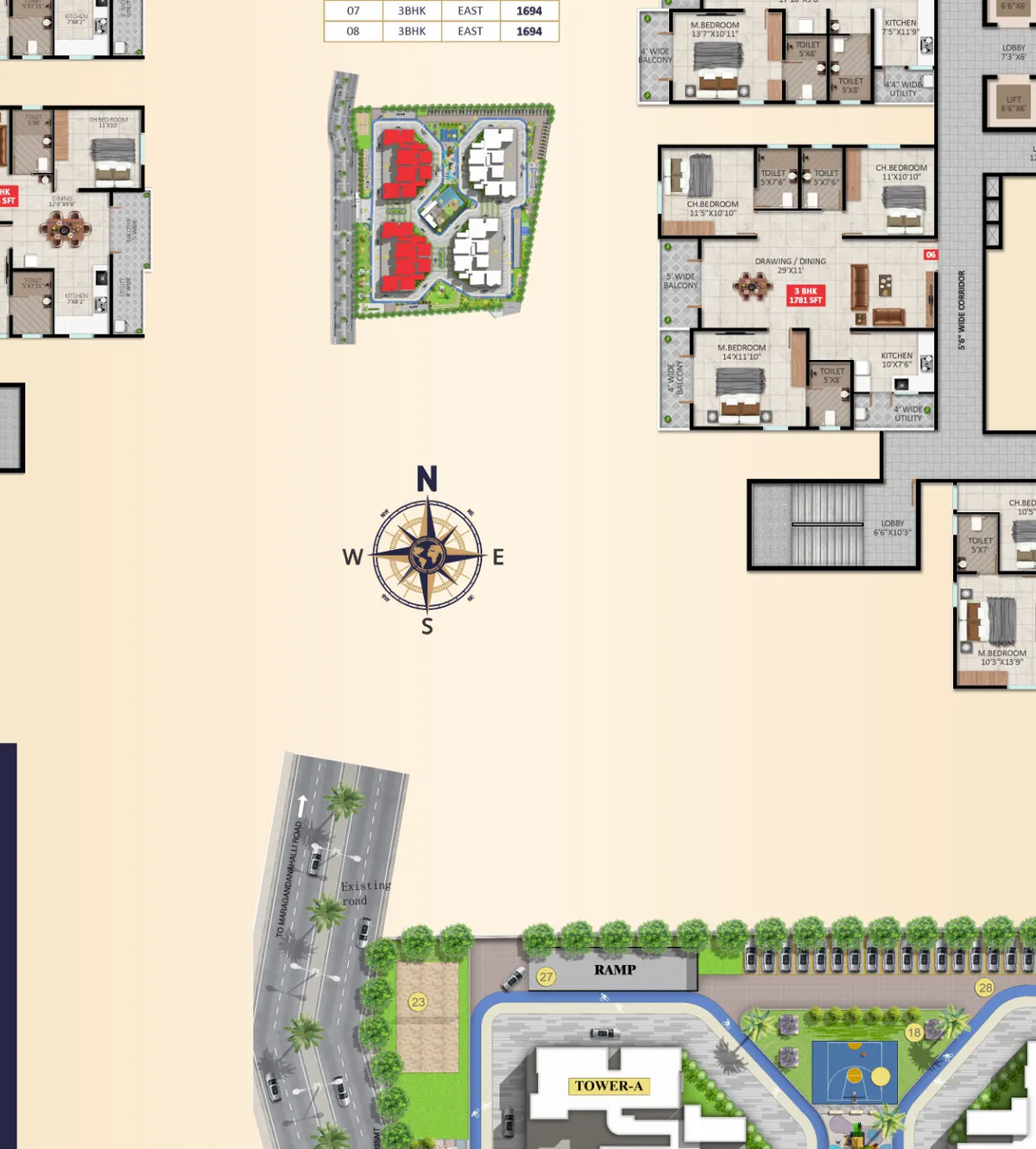
Habulus Tranquil master plan showing towers, clubhouse, and open-space zones

Master-plan reference

The published plan sheet helps explain how the towers, clubhouse, greens, and active recreation zones are intended to work together.

How the plan is supposed to work

Planning element Why it matters
Four-tower layout Helps the project avoid the denser podium-plus-many-blocks feel common in crowded apartment launches.
75 percent open-space claim Signals that landscape and movement are intended to be part of the product, not just residual buffer.
25,000 sq ft clubhouse Acts as a central social anchor, making the community proposition stronger for long-stay families.
Distributed amenity zones Improves the chance that children, seniors, wellness users, and sports users can all find usable space.
Sky-garden and landscape language Adds vertical and horizontal green identity to what could otherwise feel like a plain tower cluster.

Tower spacing

Tower-to-tower distance is one of the first things to examine on site. Good spacing affects privacy, daylight, breeze, and the sense of openness from both lower and higher floors. A strong master plan should make the community feel breathable, not merely large on a brochure.

Clubhouse relationship

A 25,000 sq ft clubhouse sounds attractive, but its real value depends on where it sits in the internal movement pattern. If it is easy to access from all towers and visually integrated with open areas, it becomes a daily-use facility rather than an isolated showpiece.

Active vs quiet zones

The site needs a sensible separation between sports, children’s activity, senior seating, and quieter residential edges. Buyers should verify that the project does not push noisy functions too close to homes that are otherwise sold on privacy and calm.

Open Space Quality

The 75 percent open-space claim is valuable only if the spaces are genuinely usable.

Projects often advertise large open-space percentages, but those numbers can include buffers and setbacks that do not improve everyday life very much. At Habulus Tranquil, the more meaningful question is how much of the promised open area becomes real community space with walking loops, children’s play, seating, greenery, and a comfortable relationship to the towers.

If the landscape works only as a visual border, the community can still feel tight. If the greens are programmed and connected, the site feels larger and calmer than the unit count alone suggests. That distinction matters in Electronic City because many projects compete on pricing first and community comfort second. Habulus Tranquil is clearly trying to reverse that hierarchy.

The master-plan image supports that intent by placing towers, amenities, and open zones in a way that reads more like a family-oriented campus than a pure driveway-and-block layout. That is one of the stronger things the project has going for it.

Community Sequence

The master-plan promise matters most after possession, when movement and common areas begin to shape daily routines.

Under-construction projects often look most convincing when seen from above, but the real test comes later: how the towers open toward shared greens, whether the clubhouse becomes a central habit or an isolated block, and whether children, seniors, and wellness users can all move through the site comfortably. Habulus Tranquil's current plan language suggests a community meant to feel complete rather than merely saleable.

That is also why the timeline should be read together with the plan. The builder target of June 2028 and the RERA date of December 2031 frame not only tower delivery but also the maturity of the common spaces. A family choosing this project is not just buying a home; it is buying into a site plan that is expected to carry daily life for years.

In this sense, the master plan is one of Habulus Tranquil's strongest differentiators. A project with larger homes but weak site planning often loses its appeal quickly after occupancy. A project that gets both the homes and the community layout broadly right has a much better chance of aging well.

Movement quality

The best-planned communities make internal movement obvious and comfortable. Habulus Tranquil's master-plan language suggests that daily circulation between towers, greens, and the clubhouse is meant to be part of the residential appeal.

Quiet and active zones

A family-oriented plan works better when children, sports, wellness, and quieter seating spaces do not fight each other. The published plan reads as though the project is trying to create that balance rather than clustering everything into one hard podium block.

Long-term livability

Master planning affects daily life long after brochure excitement fades. Better tower spacing, more visible greens, and a clubhouse placed at the heart of the community can materially improve how the project feels after occupancy.

Next Step

Need the current master-plan image, amenity note, or tower-position explanation?

The Habulus Tranquil project desk can share the latest planning material and help map your preferred layout against the wider community plan.